The 6 Pages ChatGPT Reads Before It Recommends an MSP (We Tested 1,500 Prompts)
In 95% of 1,500 buyer prompts, ChatGPT cited an MSP's own website before naming it. These are the six pages it read.

Founder, Aquinel · Published · 9 min read · Data collected October 2026
We tested 1,500 buyer prompts to find the 6 pages ChatGPT reads before it recommends an MSP. Here is what one of those prompts looks like from the buyer's side.
A clinic manager types "Best IT support companies for medical practices in Houston" into ChatGPT. A few seconds later she has a short list of names.
She will call one of them, maybe two. The MSPs that were left out never learn the question was asked.
So how did ChatGPT pick them? In 95% of our prompts, it cited at least one MSP's own website before it recommended anyone. It checked the same handful of pages again and again.
Below is each page, how often it was cited, and what it needs to say.
What we tested
We ran 1,500 prompts, and every one came back with company recommendations.
Each prompt is a question a real buyer would type. "Which IT companies provide HIPAA-compliant managed IT services for small clinics?" is one. "Which companies can migrate our business from Google Workspace to Microsoft 365?" is another.
We built the set from three things buyers put in a question: their industry, their city and the service they need. The industries included healthcare, legal, manufacturing and more. The cities were spread across the US. It is the same approach we describe in how we pick prompts for an audit.
We ran every prompt through ChatGPT with web search on, from a US location, in October 2026. For each answer we logged the searches ChatGPT ran, the pages it cited and the MSPs it recommended.
One limit to keep in mind. This is one tool, one country and one month. ChatGPT changes fast, so read these numbers as a snapshot.
How ChatGPT picks an MSP
ChatGPT ran about 2 searches for each buyer question. It did not search the words the buyer typed.
It rewrote the question first. The rewrites often added "best", "2026" and the city. The Houston prompt above became "best IT support companies for medical practices in Houston Texas HIPAA healthcare managed services". The buyer never typed HIPAA. ChatGPT added it.
From there, the answers followed the same four steps.
- Search. ChatGPT turns the question into about 2 searches of its own.
- Shortlist. It collects company names from best-of lists, directories and Google Maps.
- Website check. It goes to the MSPs' own sites to see whether each company fits the question.
- Recommendation. It names a few MSPs and says why each one fits.
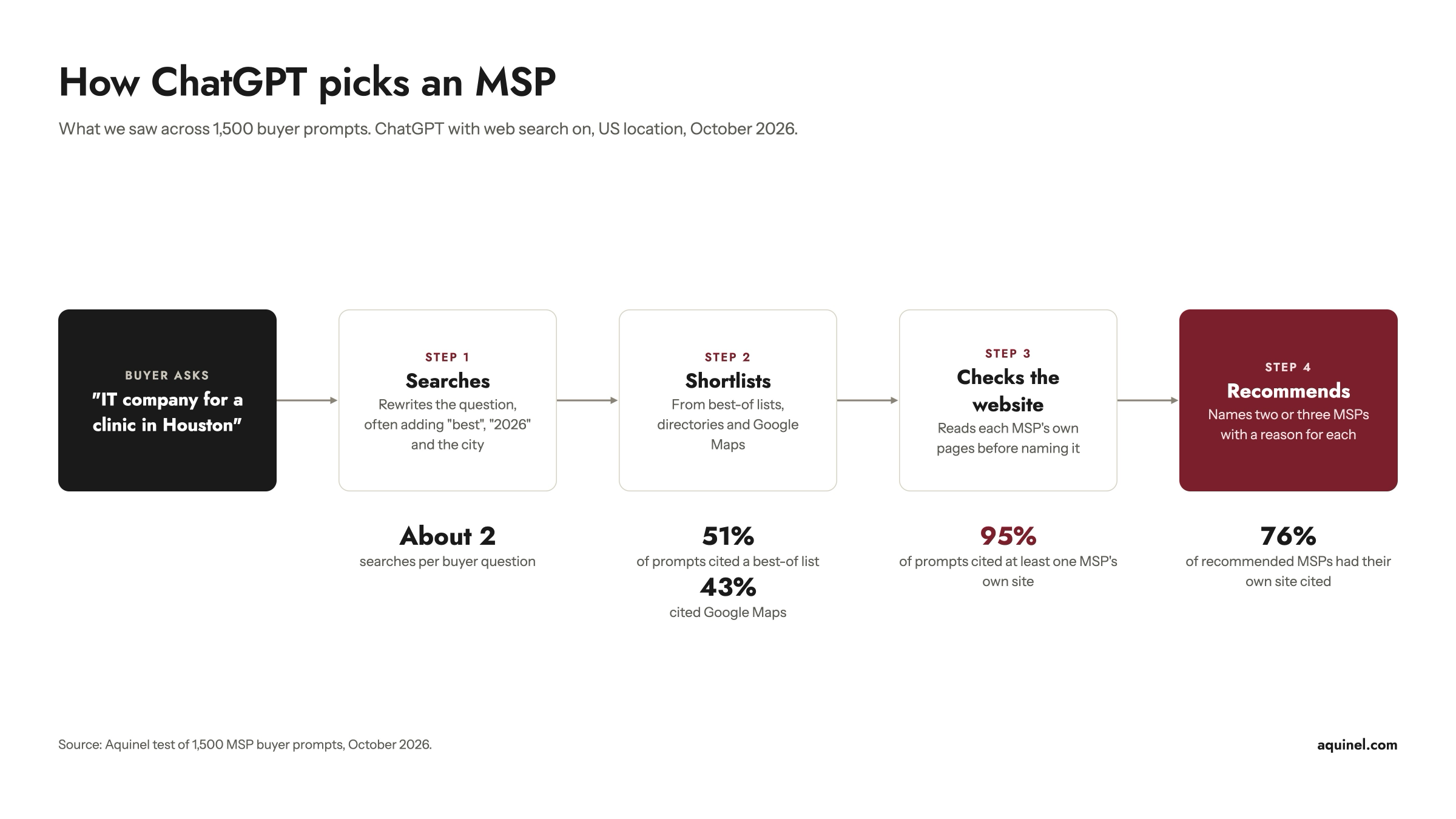
Step three is the one this post is about. In 95% of prompts, ChatGPT cited at least one MSP's own website. And 76% of recommended MSPs had their own site cited. That is 5,765 of 7,564.
A list puts your name in front of ChatGPT. Your own website is where it goes to check you.
The rest cited no MSP website at all, so this is a strong pattern and not a rule. The search steps are covered in more depth in how ChatGPT searches now.
The 6 pages it reads
Six page types took nearly every citation that went to an MSP's own site. Here they are, ranked by the share of prompts that cited each one.
| Page type | % of prompts cited | Citations | In the 6? |
|---|---|---|---|
| Homepage | 78% | 3,738 | Yes |
| Industry pages | 55% | 3,298 | Yes |
| City / location pages | 35% | 1,378 | Yes |
| Service pages | 34% | 1,256 | Yes |
| Industry + city pages | 19% | 634 | Yes |
| Pricing page | 6% | 205 | Yes |
| About page | 3% | Not reported | No |
| Partner / certification pages | 1% | Not reported | No |
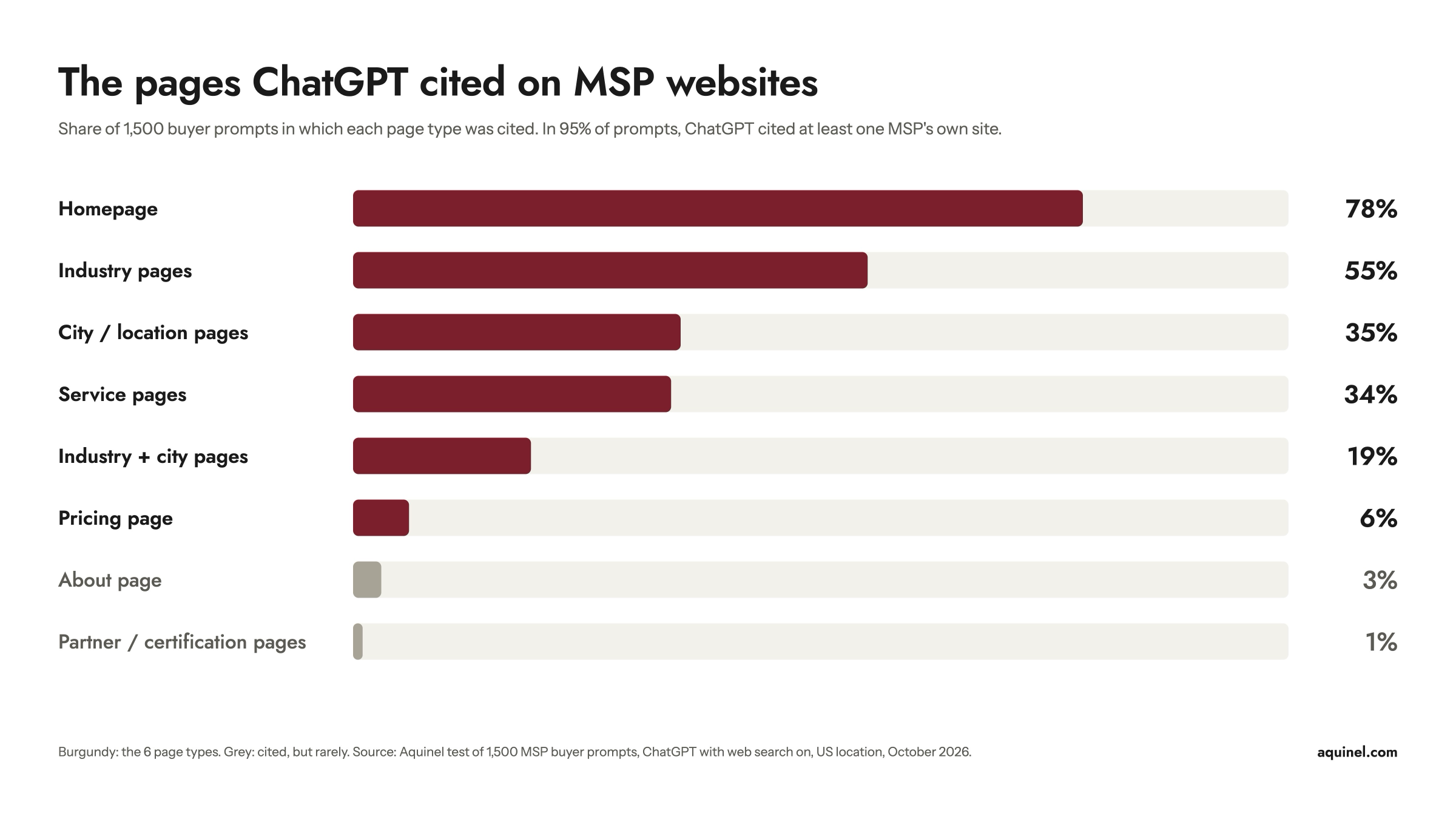
The shares add up to more than a hundred because one answer often cites several page types.
Two pages MSPs put real effort into barely appeared. About pages were cited in 3% of prompts. Partner and certification pages were cited in 1%. That is why they are not in the six.
Homepage
The homepage was cited in 78% of prompts, more than any other page. That came to 3,738 citations.
It answers the first thing ChatGPT has to settle: what is this company, and who is it for? Give it that in plain text near the top.
- What you are. Write "managed IT services" in words, not a slogan.
- Where you work. Name your city and the area around it.
- Who you serve. Name your main industries and the size of client you take on.
A homepage that opens with "Technology that empowers your business" gives ChatGPT nothing it can repeat.
Industry pages
Industry pages were cited in 55% of prompts. That is 3,298 citations, not far behind the homepage.
Buyers ask by industry. The clinic manager does not want any IT company. She wants one that knows HIPAA. The industry page answers her real question: do you understand my kind of business?
- Put the industry in the title and the first line. "IT support for healthcare clinics" works.
- Name the rules and tools that industry lives with. HIPAA for clinics. Document management for law firms.
- Show you have done it. Say the kind of client, the problem and what changed.
Build one page per industry. A single "Industries we serve" page with a row of icons does not do this job.
City / location pages
City and location pages were cited in 35% of prompts, with 1,378 citations.
Many of our prompts named a place, and ChatGPT often added the city to its own searches. The city page answers: do you really work here?
- Put the city in the title, the heading and the first sentence.
- Give your office address, or say which office covers that area.
- List the services you deliver there and how you get on site.
Do not copy one page and swap the city name. Write what is true about your work in that city.
Service pages
Service pages were cited in 34% of prompts, just behind city pages. We counted 1,256 citations.
Some buyers already know what they need. They ask for co-managed IT, or for help with a Microsoft 365 migration. The service page answers: do you do this exact thing?
- Give each service its own page. Co-managed IT gets one. A Microsoft 365 migration gets one.
- Open with a plain definition. Say what the service is and who it is for.
- List what is included, so a buyer can check it against what they need.
One long "Services" page that covers everything is hard to match to a specific question.
Industry + city pages
Industry + city pages were cited in 19% of prompts, with 634 citations. These are narrow pages, built for one industry in one city.
Think "HIPAA IT support for clinics in Houston". That is the clinic manager's question almost word for word, and the page answers all of it at once.
- Put one industry and one city in the title. Not a list of either.
- Say what you do for that industry in that city: the clients, the local rules, the response.
- Link up to the industry page and across to the city page.
Start with your strongest industry in your home city. Build that page properly before you build a grid of thin ones.
Pricing page
The pricing page was cited in 6% of prompts, with 205 citations. It is the smallest of the six, and it still beat About pages and partner pages.
A "who should I hire" question does not always mention cost. When it does, ChatGPT looks for a figure it can quote.
- Say how you charge: per user, per device or a flat monthly fee.
- Give a starting figure or a range, in text on the page.
- Say what moves the price, such as users, sites and compliance needs.
With no pricing page, ChatGPT has nothing of yours to cite on a cost question.
For the build order, see our guide to MSP website design for AI search.
The off-site half
Best-of lists were cited in 51% of prompts, and Google Maps in 43%. That is where ChatGPT went looking for names.
We counted 1,676 citations of best-of and top-N lists. These are pages like "best IT companies in Houston" or "top managed service providers for law firms". Directories showed up in the same step.
So the work has two halves. Off-site, ChatGPT finds names. On-site, it checks them. An MSP with strong pages and no mentions elsewhere may never reach the shortlist. An MSP on every list with a thin website gives ChatGPT little to confirm.
One thing stood out. Some recommended MSPs had published the lists they appeared in. An MSP writes a "best IT companies in our city" page, includes itself, and ChatGPT cites that page. We are reporting what we saw. We are not recommending it.
Google Maps in 43% of prompts means your Google Business Profile is part of this too. Keep its name, address, category and services in line with what your website says.
What didn't seem to matter
Where a page ranked barely changed whether ChatGPT cited it. A top spot was not what got a page cited.
We also saw no visible effect from schema or llms.txt. Neither one stood out in the pages ChatGPT chose to cite.
Read both points with care. This is what we saw in one test, not a law. The test was not built to prove a negative, and it covers one tool in one month.
Our read is simpler than either of those. ChatGPT cared less about how a page was tuned. It cared more about whether the page existed and matched the question.
What to do with this
ChatGPT finds MSPs on lists and maps, then checks six kinds of pages on their own websites. That is the whole finding in one line.
Go through your site with the list in hand: homepage, industry pages, city pages, service pages, industry + city pages, pricing. Mark each one as there, thin or missing.
Fix these pages and you give ChatGPT what it checks. Nobody can promise it will name you, and answers change from one run to the next.
Then ask ChatGPT your buyers' questions again, several times each. Count how often you are recommended in the answer.
Aquinel does this work for MSPs and IT services firms. See our services and SEO for MSPs.
Questions
Does ChatGPT read my MSP's website before recommending it?
Usually, yes. In 95% of the 1,500 buyer prompts we tested in October 2026, ChatGPT cited at least one MSP's own website, and 76% of recommended MSPs had their own site cited.
Which pages on an MSP website does ChatGPT cite most?
The homepage, cited in 78% of prompts, then industry pages at 55%. City pages (35%), service pages (34%), industry + city pages (19%) and the pricing page (6%) follow.
Does my MSP need a pricing page to get recommended by ChatGPT?
No, but it gives ChatGPT something to cite when a buyer asks about cost. Pricing pages were cited in 6% of prompts, the smallest share of the six page types and still ahead of About pages at 3%.
Does ranking on Google decide whether ChatGPT cites my MSP?
Not in our data. Across 1,500 prompts run in October 2026, where a page ranked barely changed whether ChatGPT cited it.
Sources
- Aquinel test of 1,500 MSP buyer prompts, Aquinel, October 2026. aquinel.com/blog/pages-chatgpt-reads-before-recommending-msp
If you would like us to walk you through how this would work for your firm, the call is free.